
Shopify Store Churn Rate 2026: Why 70% of E-commerce Businesses Fail
E-commerce has the highest failure rate of any business type. Here's the data on why most Shopify stores don't survive—and what the successful ones do differently.
Shopify Store Survival: The Hard Truth
TL;DR
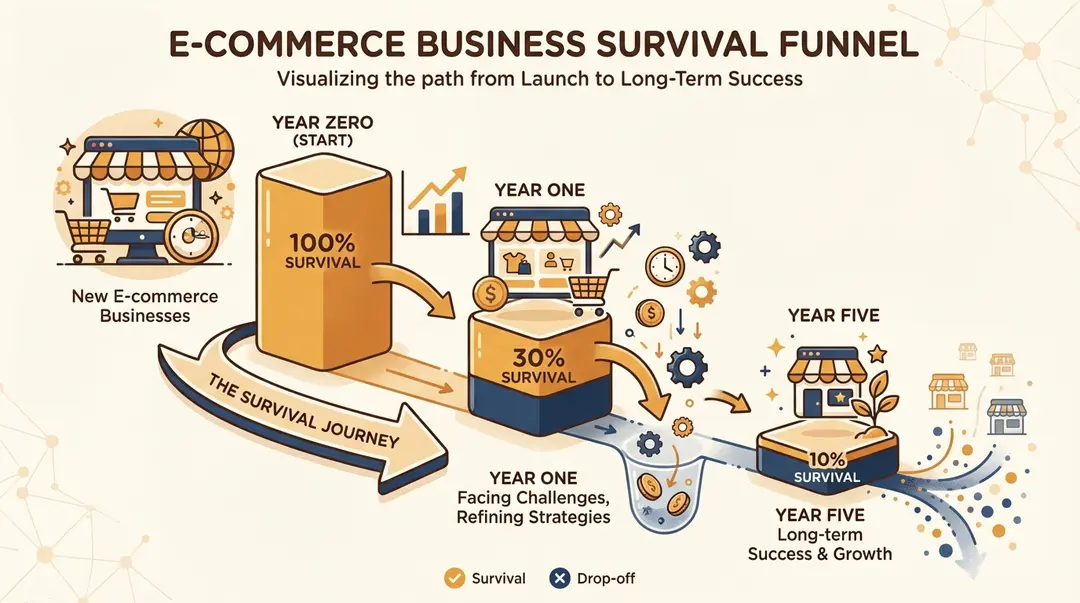
70% of e-commerce businesses fail in year one—more than double the 20% failure rate for general businesses. Only 10% of new Shopify stores remain active after 90 days. Annual merchant churn is 28%. The primary causes: inadequate marketing (37%), low conversion rates (1.4-2.5% average), and failure to retain customers. Stores that focus on customer retention and maximize revenue per customer survive at 3x the rate of those that don't.
Shopify churn rate refers to the percentage of Shopify merchants who close their stores or stop selling within a given period. In 2026, annual merchant churn on Shopify is approximately 28%, with only 10% of new stores remaining active after 90 days.
Starting an e-commerce store has never been easier. Shopify has removed nearly every technical barrier to launching an online business. But that accessibility creates a paradox: while anyone can start a store, very few can sustain one.
The data is sobering. E-commerce businesses fail at more than double the rate of traditional businesses, and most don't make it past their first few months. Here's what the numbers actually show—and what separates the survivors from the casualties.
70%
First-Year Failure
E-commerce failure rate
10%
90-Day Survival
New stores still active
28%
Annual Churn
Shopify merchant churn rate
5-10%
Success Rate
Stores that become profitable
Shopify & E-commerce Failure Rate Statistics
According to Companies House data analyzed by e-commerce accountants, the numbers paint a stark picture[1][2]:
| Timeframe | E-commerce Failure Rate | General Business Rate |
|---|---|---|
| First Year | 70% | 20.4% |
| First 5 Years | ~90% | 49.4% |
| First 10 Years | ~95% | 65.3% |
“7 in 10 e-commerce businesses fail in their first year—more than double the average rate of business failure across all industries.”
Why E-commerce Failure Is Higher
E-commerce failure rates are significantly higher than general business failure rates for several structural reasons:
Low Barrier to Entry
Anyone can launch a store in hours, but most lack the skills to operate one profitably
Intense Competition
Competing against millions of stores and Amazon for the same customers
Customer Acquisition Costs
Paid advertising costs have increased 200%+ over the past 5 years
Operational Complexity
Inventory, fulfillment, returns, and customer service require expertise
2025-2026 E-commerce Growth
In 2024, 56,616 new e-commerce businesses were created in the UK alone (down from 67,186 in 2023). The total cumulative number of active e-commerce businesses reached 166,052—the highest ever. But the high creation rate masks the equally high dissolution rate[3].
Shopify-Specific Churn Data
Shopify powers over 4.8 million active stores globally, but the platform sees significant merchant turnover[4][5]:
28%
Annual Churn
Merchants leaving Shopify yearly
10%
90-Day Active
New stores surviving 3 months
4.8M
Active Stores
Total Shopify stores globally
1.4%
Avg Conversion
Typical Shopify conversion rate
The 90-Day Cliff
Perhaps the most telling statistic: only 1 in 10 new Shopify stores remains active after 90 days. This early mortality rate reveals that most stores fail before they even have a chance to find product-market fit.
| Store Stage | Survival Rate | Key Challenge |
|---|---|---|
| 30 Days | ~40% | No sales, losing motivation |
| 90 Days | 10% | Can't acquire customers profitably |
| 1 Year | ~30% | Cash flow, operational challenges |
| 5 Years | ~10% | Competition, market changes |
Enterprise vs SMB Survival
Interestingly, enterprise-level Shopify stores (those with $50M+ GMV) show much stronger retention. Over 42% of new enterprise launches in the past two years chose Shopify, with net additions of over 1,200 enterprise brands annually[5].
This suggests that the churn problem is concentrated among smaller, newer stores—the businesses that can least afford to make acquisition and retention mistakes.
Why Shopify Stores Fail
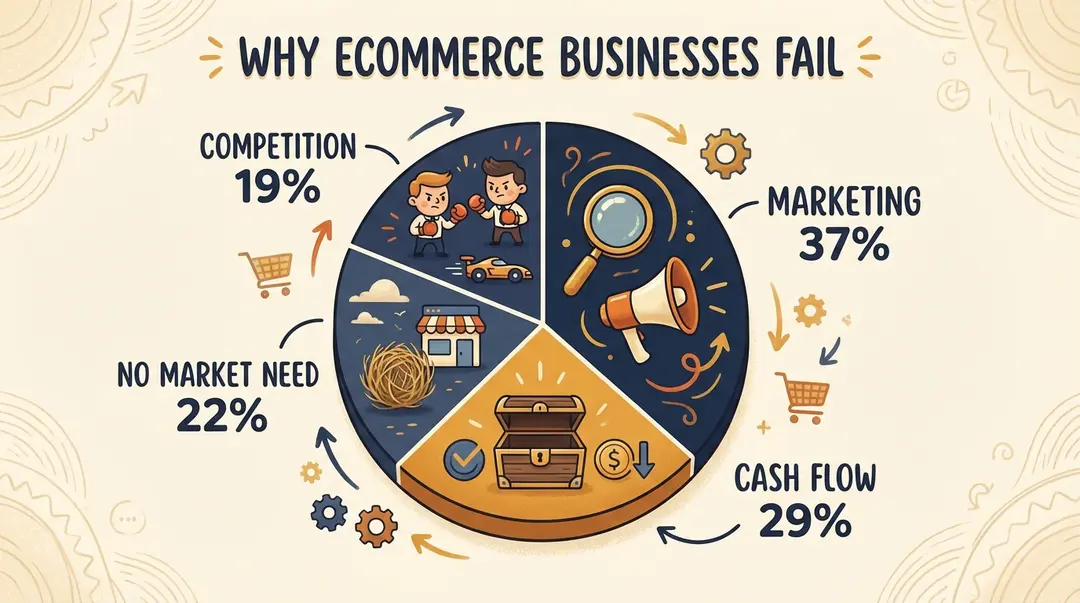
Research into e-commerce failure reveals consistent patterns[6][7]:
Top Reasons for E-commerce Failure
| Reason | % of Failures | Description |
|---|---|---|
| Inadequate Marketing | 37% | Can't drive traffic or acquire customers affordably |
| Cash Flow Problems | 29% | Run out of money before reaching profitability |
| No Market Need | 22% | Selling products nobody wants to buy |
| Competition | 19% | Outcompeted on price, selection, or experience |
| Pricing Issues | 18% | Margins too thin to sustain operations |
| Poor Customer Retention | 14% | Can't get customers to come back |
The Acquisition Trap
Most failing stores share a common pattern: they spend all their resources acquiring new customers while ignoring the customers they already have. With customer acquisition costs rising 200%+ over five years, this approach is increasingly unsustainable.
The Math That Kills Stores
Consider typical Shopify store metrics:
| Metric | Average Value | Problem |
|---|---|---|
| Conversion Rate | 1.4-2.5% | 97%+ of visitors don't buy |
| Customer Acquisition Cost | $30-50+ | Often exceeds first order profit |
| Average Order Value | $50-80 | Thin margins after costs |
| Repeat Purchase Rate | 27% | 73% never buy again |
If you're paying $40 to acquire a customer who spends $60 with a 30% margin, you make $18 gross profit—a $22 loss on the first order. You need that customer to come back to break even. But with a 27% repeat purchase rate, most never do.
“The stores that survive aren't the ones with the best products or the lowest prices. They're the ones that figured out how to make customers come back.”
What Successful Shopify Stores Do Differently
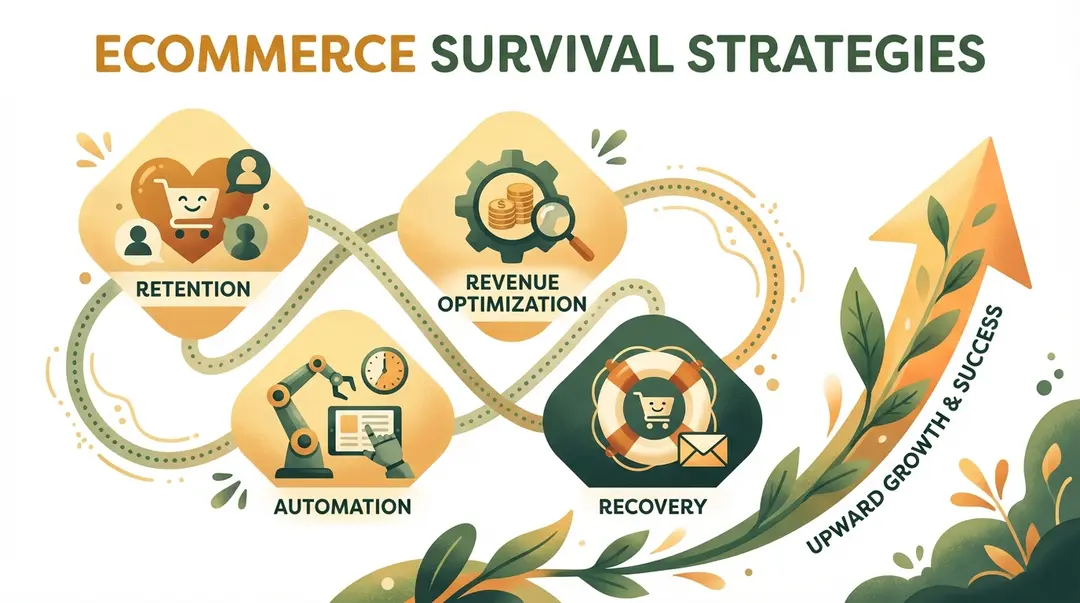
The 5-10% of Shopify stores that become sustainably profitable share common characteristics:
1. They Prioritize Retention Over Acquisition
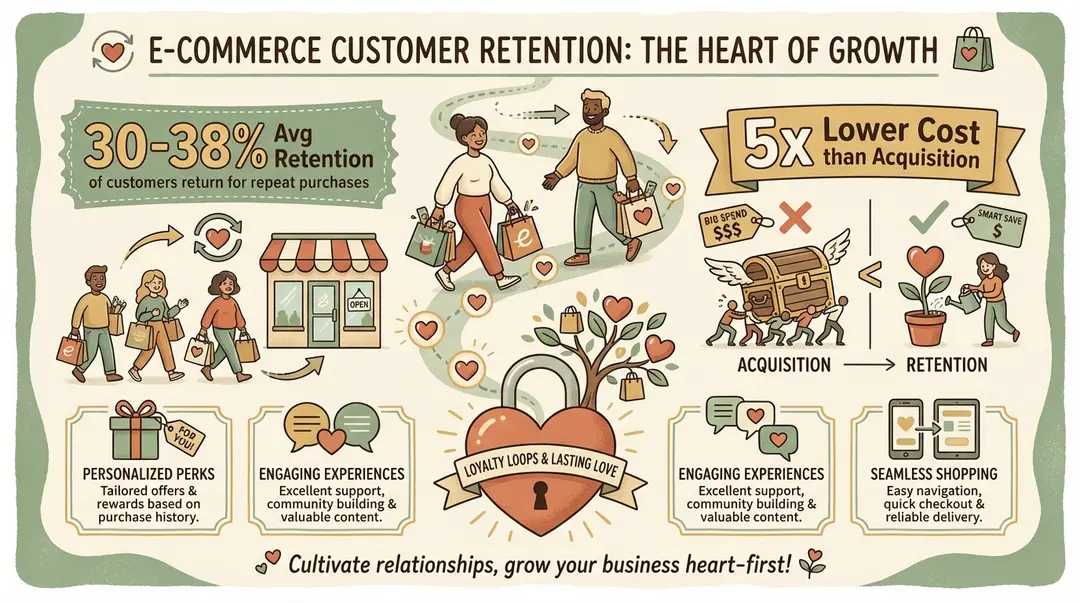
Successful stores understand that acquiring a new customer costs 5-7x more than retaining an existing one. They invest heavily in post-purchase experience, loyalty programs, and repeat purchase incentives.
5x
Lower Cost
Retention vs acquisition
67%
Higher Spend
Repeat customers vs new
60-70%
Probability
Existing customer converts
5-20%
Probability
New prospect converts
2. They Maximize Revenue Per Customer
Rather than chasing more customers, successful stores focus on increasing:
Average Order Value (AOV)
Through bundling, upsells, and cross-sells at checkout and post-purchase
Purchase Frequency
Using email, SMS, and loyalty programs to drive repeat purchases
Customer Lifetime Value (CLV)
Building relationships that last years, not transactions
Maximize revenue from every customer
Upsella sends AI-powered SMS upsells after each purchase. When customers reply, our AI responds instantly—turning one-time buyers into repeat customers.
3. They Recover Abandoned Revenue
With 70% of shopping carts abandoned, successful stores have robust recovery systems for both cart abandonment and browse abandonment. They don't leave money on the table.
4. They Automate What They Can
Time is the scarcest resource for small e-commerce businesses. Survivors use automation for marketing, customer service, inventory management, and fulfillment—freeing themselves to focus on strategy and product.
Key Shopify Metrics That Predict Survival
Stores that track and optimize these metrics survive at significantly higher rates:
Customer Lifetime Value (CLV)
The total revenue a customer generates over their relationship with your store. Healthy e-commerce businesses have CLV:CAC ratios of at least 3:1.
| CLV:CAC Ratio | Status | Action |
|---|---|---|
| < 1:1 | Unsustainable | Losing money on every customer |
| 1:1 - 2:1 | Struggling | Barely breaking even |
| 3:1+ | Healthy | Profitable, can invest in growth |
| 5:1+ | Thriving | Strong unit economics |
Average Order Value (AOV)
Higher AOV means more revenue per transaction, better margins, and lower relative fulfillment costs. Shopify stores average $50-80 AOV, but top performers often exceed $100.
The AOV Lever
Increasing AOV by just 10% can have the same profit impact as acquiring 25-30% more customers—but it's far easier and cheaper to accomplish. Upsells, cross-sells, and bundling at checkout are the primary tools.
Repeat Purchase Rate
The percentage of customers who make more than one purchase. E-commerce average is around 27%, but top-performing stores achieve 40-60%.
Customer Retention Rate
E-commerce retention averages 30-38%. A 5% improvement in retention can boost profits by 25-95%[8].
Retention: The Survival Multiplier
The data is clear: stores that prioritize customer retention survive at dramatically higher rates than those focused solely on acquisition.
Why Retention Determines Survival
Pros
- Repeat customers spend 67% more than new customers
- Retention costs 5x less than acquisition
- Repeat customers have 60-70% conversion rates vs 5-20% for new prospects
- Word-of-mouth from loyal customers reduces marketing costs
- Higher CLV allows you to outbid competitors on ads
Cons
- Acquisition-only strategies become unprofitable as ad costs rise
- One-time buyers often cost more to acquire than they generate
- No retention = no referrals = higher CAC over time
- Inventory forecasting is harder without repeat customer data
Practical Retention Strategies
Post-Purchase SMS & Email
Thank customers, provide shipping updates, and suggest complementary products
Loyalty Programs
Reward repeat purchases with points, discounts, or exclusive access
Abandoned Cart Recovery
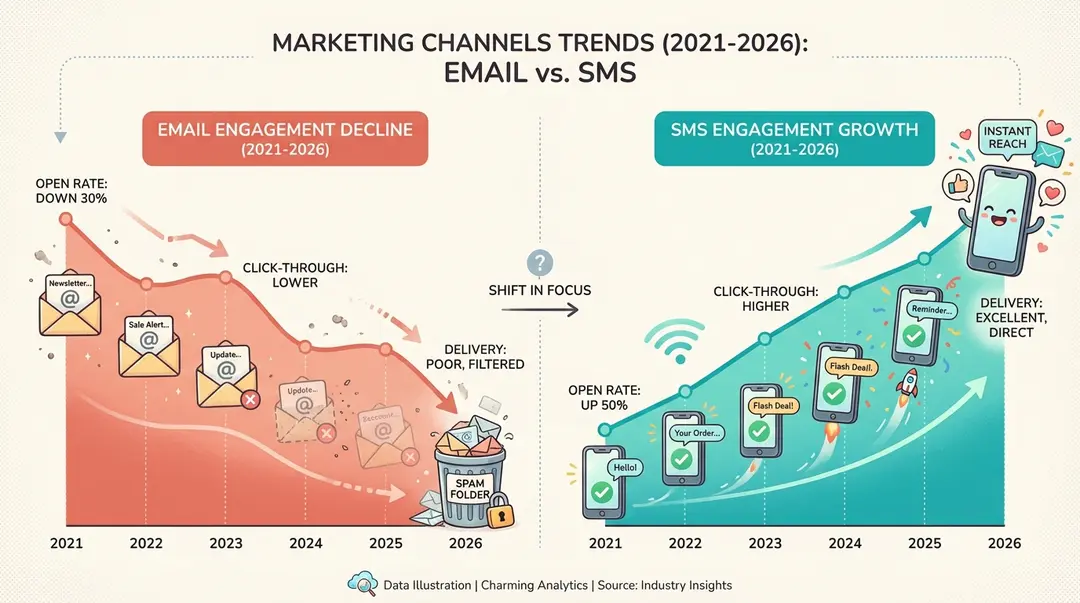
Recover 10-15% of abandoned carts with SMS (vs 3-5% with email alone)
Personalized Recommendations
Use purchase history to suggest relevant products
Win-Back Campaigns
Re-engage customers who haven't purchased in 60-90 days
Turn one-time buyers into repeat customers
Upsella automates post-purchase SMS with AI-powered personalization. Customers who receive post-purchase upsells have 3x higher repeat purchase rates.
The Retention Math
If your store has 1,000 customers with a 27% repeat purchase rate, that's 270 repeat buyers. Improving to 40% gives you 400 repeat buyers—130 additional orders with near-zero acquisition cost. At $80 AOV, that's $10,400 in additional revenue from the same customer base.
FAQ
What is the Shopify store failure rate?
Approximately 70% of e-commerce stores fail in their first year, and only about 10% of new Shopify stores remain active after 90 days. The annual merchant churn rate on Shopify is approximately 28%.
Why is the e-commerce failure rate so high?
E-commerce has a higher failure rate than traditional businesses (70% vs 20%) due to low barriers to entry (anyone can start), intense competition (millions of stores), rising customer acquisition costs, and the operational complexity of managing inventory, fulfillment, and customer service.
What percentage of Shopify stores are successful?
Only about 5-10% of Shopify stores become sustainably profitable. The widely quoted "success rate" of 5-10% means that 90-95% of stores either fail outright or never reach meaningful profitability.
How can I improve my store's survival chances?
Focus on customer retention over pure acquisition. Increase your CLV:CAC ratio to at least 3:1. Maximize revenue per customer through upsells, cross-sells, and repeat purchase incentives. Automate marketing and recovery flows to save time and capture revenue you're currently losing.
What's the most important metric for store survival?
Customer Lifetime Value to Customer Acquisition Cost ratio (CLV:CAC). If this ratio is below 3:1, your unit economics are likely unsustainable. The most successful stores have ratios of 5:1 or higher.
Why do so many stores fail in the first 90 days?
Most stores fail early because they can't acquire customers profitably. They launch without a clear customer acquisition strategy, spend their budget on ineffective ads, get no sales, and give up. The stores that survive past 90 days have usually found at least one profitable customer acquisition channel.
Conclusion
The data is sobering: 70% of e-commerce businesses fail in their first year, and only 10% of new Shopify stores survive past 90 days. But these statistics aren't destiny—they're the result of predictable, avoidable mistakes.
The stores that survive share common traits: they prioritize retention over acquisition, they maximize revenue per customer, they recover abandoned carts and lapsed customers, and they automate what they can.
If you're running a Shopify store in 2026, the path to survival is clear. Stop chasing new customers at any cost. Start investing in the customers you already have. Every percentage point improvement in retention, every dollar added to AOV, every abandoned cart recovered—these compound into the difference between the 70% that fail and the 30% that survive.
The tools to improve these metrics exist. The question is whether you'll use them.
Join the stores that survive
Upsella helps Shopify stores increase customer lifetime value through AI-powered SMS upsells. Merchants using post-purchase SMS see 15-25% more revenue from existing customers.
References
- [1] SME News. "7 in 10 E-commerce Businesses Fail in Their First Year." February 2025.smenews.digital
- [2] U.S. Bureau of Labor Statistics. "Business Employment Dynamics." 2024.bls.gov
- [3] Your Ecommerce Accountant. "The Number of New Ecommerce Businesses 2025." January 2025.yourecommerceaccountant.co.uk
- [4] Go For Free Trial. "Shopify Statistics 2026." 2025.goforfreetrial.com
- [5] Omnisend. "Shopify Statistics 2026: Latest Usage, Sales, and Trends." November 2025.omnisend.com
- [6] OpenDesk. "Why 80% of Shopify Brands Fail in the First Year." January 2025.tryopendesk.com
- [7] Chargebacks911. "Key Shopify Statistics & Indicators for 2026." December 2025.chargebacks911.com
- [8] Bain & Company. "Prescription for Cutting Costs." Customer retention research.
Ready to boost your revenue with SMS upsells?
Upsella automatically sends AI-powered SMS upsells after customer purchases. Start your free trial today and unlock hidden revenue effortlessly.
Related Articles
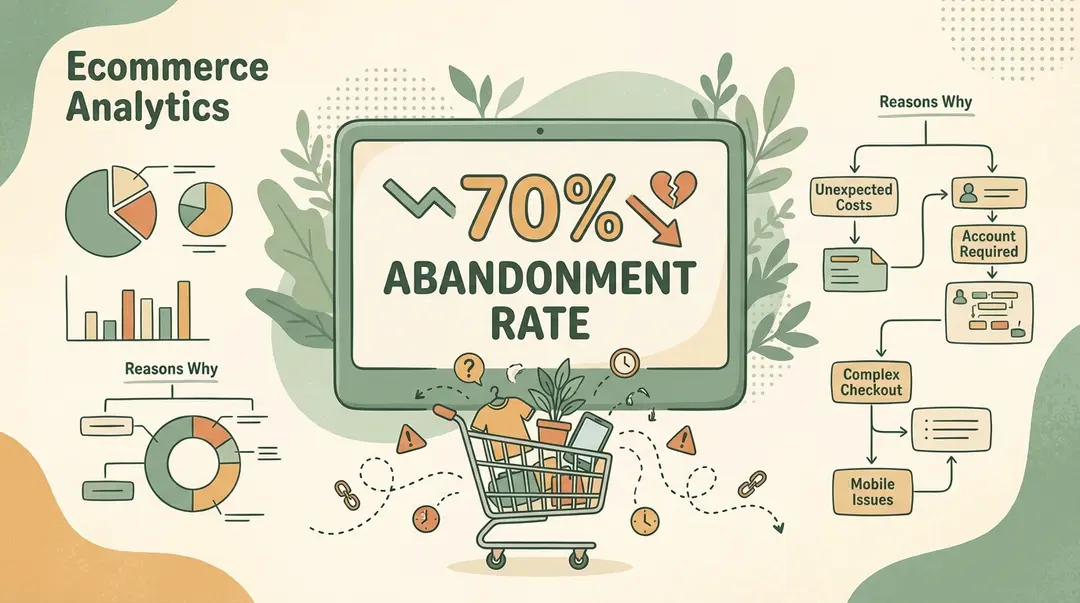
Cart Abandonment Statistics 2026: What Every Shopify Store Should Know
Nearly 7 out of 10 shopping carts are abandoned before checkout. Here
Customer Retention Rate: Benchmarks & Strategies for Shopify (2026)
Acquiring a new customer costs 5x more than keeping an existing one. Here
Why Email Abandoned Cart Recovery Is Declining in 2026 (And What to Do Instead)
Your abandoned cart emails aren