
Why Email Abandoned Cart Recovery Is Declining in 2026 (And What to Do Instead)
Your abandoned cart emails aren't performing like they used to. Here's the data on why email recovery rates are dropping—and what's actually working now.
The Email Cart Recovery Problem in 2026
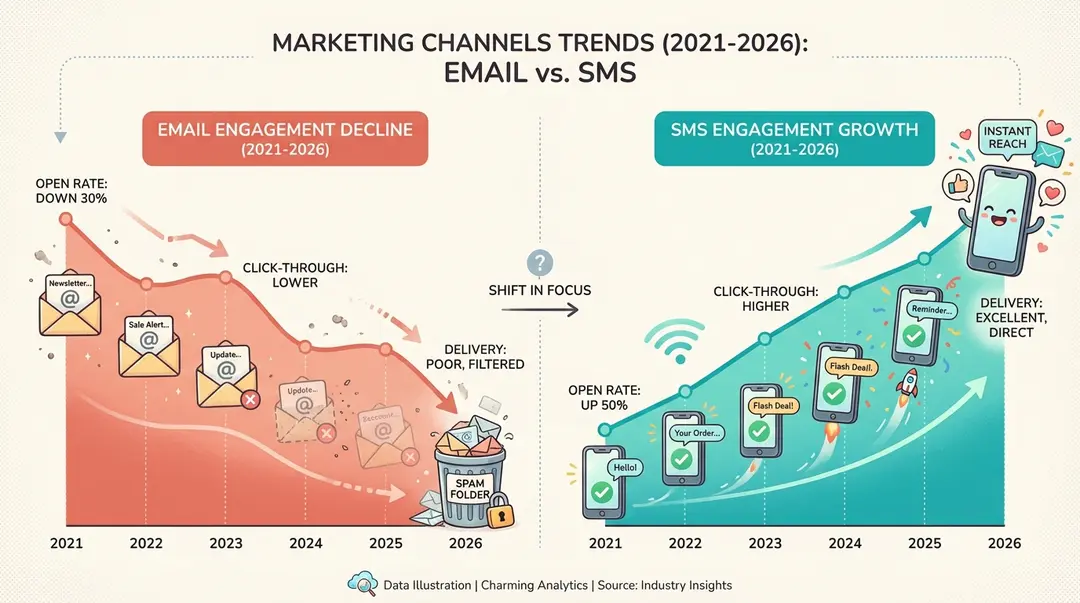
TL;DR
Email cart recovery averages just 3-5% in 2026. iOS Mail Privacy Protection broke open rate tracking in 2021. Gmail sends 10.5% of marketing emails to spam. Email response time is 90 minutes vs 90 seconds for SMS. SMS now recovers 10-15% of abandoned carts—3x better than email. The solution: add SMS to your recovery flow.
Email abandoned cart recovery is the percentage of abandoned shopping carts recovered through email follow-ups. In 2026, email recovery rates average just 3-5%—down from historical highs—due to iOS privacy changes, spam filtering, and email fatigue.
If you've noticed your abandoned cart email performance declining, you're not imagining it. Merchants across Shopify are reporting the same thing: open rates that don't make sense, click-through rates dropping, and recovery rates that used to be higher.
The data confirms what you're experiencing. While email marketing isn't dead, its effectiveness for time-sensitive recovery campaigns has been eroding since 2021. Here's why—and what the smartest Shopify stores are doing about it.
3-5%
Email Recovery Rate
Average cart recovery via email
10-15%
SMS Recovery Rate
3x higher than email
10.5%
Emails to Spam
Never seen by customers
52%
Apple Mail Users
Affected by privacy changes
iOS Mail Privacy Protection: The Silent Killer
In September 2021, Apple launched Mail Privacy Protection (MPP) with iOS 15. This single change fundamentally broke how email marketers track engagement[1][2].
What MPP Does
When a user enables MPP (which Apple prompts by default), the Apple Mail app automatically preloads all email content—including tracking pixels—regardless of whether the user actually opens the email. This means:
Inflated Open Rates
Tracking pixels fire even when emails aren't read, making open rates artificially high and unreliable
Hidden User Data
IP addresses, device info, and location are masked, breaking personalization and segmentation
Broken Engagement Scoring
You can't tell who's actually engaged vs who never saw your email
Faulty Automation Triggers
Workflows based on 'opened email' now trigger incorrectly
The Scale of the Problem
This isn't a niche issue. Apple devices account for approximately 52% of all email opens[2]. With MPP adoption rates exceeding 96% among iOS users, this means roughly half of your email list is giving you unreliable engagement data.
Your Open Rates Are Lying
If your abandoned cart emails show 40-50% open rates, that number is likely inflated by MPP false positives. The actual engagement could be significantly lower—but you have no way to know for sure.
“Apple's iOS changes are wreaking havoc on email deliverability. Marketers who built their strategies around open rates are finding their entire foundation compromised.”
iOS 18 and Beyond
Apple continues to strengthen privacy protections. iOS 18 expanded these features, and iOS 26 previews suggest even stronger pixel neutralization and AI-powered inbox prioritization that may further reduce email visibility[3].
Gmail & Spam Filter Changes
While Apple broke your tracking, Gmail is increasingly blocking your emails from being seen at all.
The Deliverability Crisis
Recent data shows concerning trends in email deliverability[4]:
| Metric | Value | Impact |
|---|---|---|
| Gmail Primary Inbox Placement | 87.2% | Down from previous quarters |
| Overall Email Deliverability | 83.1% | 17% never reach inbox |
| Emails Sent to Spam | 10.5% | 1 in 10 emails blocked |
| Promotions Tab Placement | ~30% | Delayed visibility |
Gmail's 2024 Spam Policy Changes
In early 2024, Gmail implemented stricter spam thresholds requiring bulk senders to:
Keep Spam Complaints Under 0.1%
Even a small spike in complaints can trigger filtering for your entire domain
Authenticate with DKIM, SPF, DMARC
Technical requirements that many Shopify stores haven't properly configured
Include Easy Unsubscribe
One-click unsubscribe required in headers, not just email body
The Promotions Tab Problem
Even if your email doesn't hit spam, landing in Gmail's Promotions tab means delayed visibility. Studies show emails in Promotions receive 2x lower engagement than Primary inbox emails. For time-sensitive cart recovery, this delay can be fatal.
Email Fatigue Is Real
Beyond technical issues, there's a human problem: your customers are drowning in email.
The Inbox Overload
The average person receives 121 emails per day. Marketing emails compete with work communications, personal messages, newsletters, and countless other notifications. Your abandoned cart email is one of dozens fighting for attention.
121
Emails Per Day
Average inbox volume
90 min
Email Response Time
Average time to read
47%
Unread Emails
Never opened at all
8 sec
Attention Span
Average email scan time
The Timing Problem
Cart abandonment recovery is time-sensitive. The ideal window to recover a cart is within 1-4 hours of abandonment[5]. But email has a fundamental timing problem:
| Channel | Average Response Time | Recovery Window Fit |
|---|---|---|
| SMS | 90 seconds | Excellent |
| Push Notification | ~5 minutes | Good |
| 90 minutes | Poor |
By the time most customers check their email, they've either forgotten about their cart, purchased elsewhere, or the urgency has passed.
“Email marketing isn't dead, but for time-sensitive use cases like cart recovery, it's increasingly the wrong tool for the job.”
Email vs SMS: The Numbers
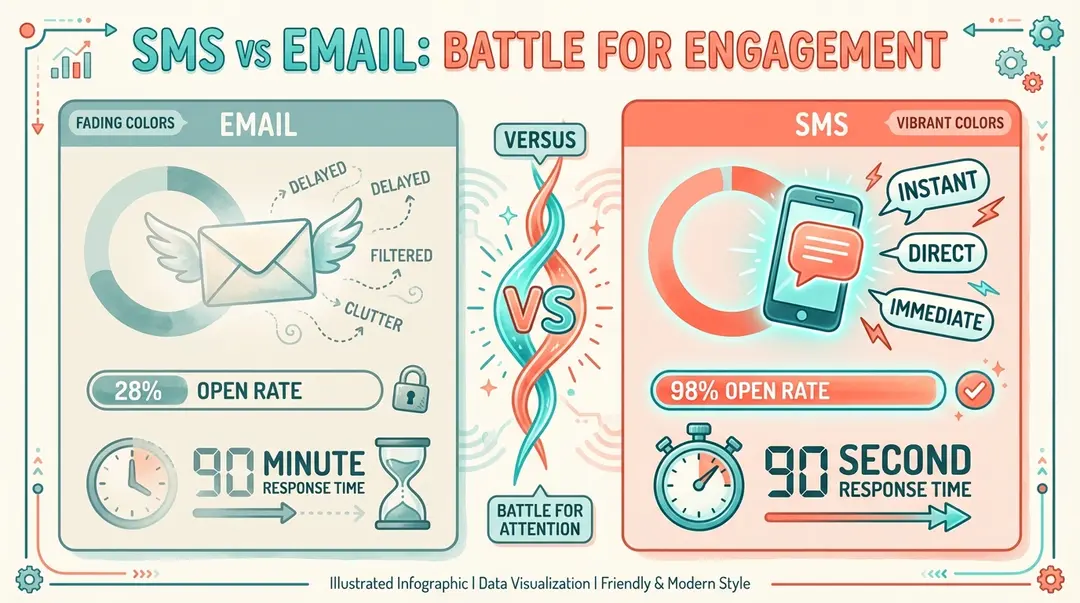
Let's look at the actual performance data comparing email and SMS for cart recovery[6][7]:
| Metric | SMS | Difference | |
|---|---|---|---|
| Open Rate | 20-28%* | 98% | SMS 3.5-5x higher |
| Click-Through Rate | 2.5-6.25% | 19-36% | SMS 4-7x higher |
| Cart Recovery Rate | 3-5% | 10-15% | SMS 3x higher |
| Response Time | 90 minutes | 90 seconds | SMS 60x faster |
| Deliverability | 83.1% | 98%+ | SMS more reliable |
*Email open rates are unreliable due to iOS Mail Privacy Protection. Actual engagement is likely lower.
3x
Higher Recovery
SMS vs email cart recovery
98%
SMS Open Rate
Nearly every text is read
60x
Faster Response
90 seconds vs 90 minutes
$71
SMS ROI per $1
vs $36-42 for email
Revenue Per Message
Abandoned cart SMS generates $3.46-$10.78 revenue per message on average. With SMS costs around $0.01-0.05 per message, that's an ROI that email simply can't match for recovery campaigns.
Why SMS Is Winning for Cart Recovery
The shift from email to SMS for cart recovery isn't arbitrary—it's driven by fundamental differences in how these channels work:
1. No Spam Folder
SMS arrives directly in the customer's message inbox. There's no spam filter, no promotions tab, no algorithmic sorting. When you send a text, it arrives.
2. No Privacy Pixel Issues
SMS doesn't rely on tracking pixels for engagement data. When you send an SMS with a link, you know exactly who clicked. The data is reliable.
3. Immediate Attention
People check their texts immediately. The 90-second average response time means your recovery message reaches customers while they still remember what they were shopping for.
4. Two-Way Conversation
Unlike email where replies often go into a black hole, SMS enables real conversation. Customers can ask questions about products, shipping, or sizing—and get immediate answers.
SMS that actually talks back
Upsella uses AI to respond to customer replies in real-time. When a customer asks 'is this in stock?' or 'what size should I get?', our AI answers instantly—turning questions into sales.
Multi-Channel Is the Answer
The data shows that combining SMS with email produces the best results[7]:
10-20%
Combined Recovery
SMS + email together
56%
Higher ROI
Multi-channel vs email only
Email still has a role—it's better for longer-form content, brand building, and customers who prefer it. But for time-sensitive recovery, SMS should be your primary channel.
How to Fix Declining Email Abandonment Recovery
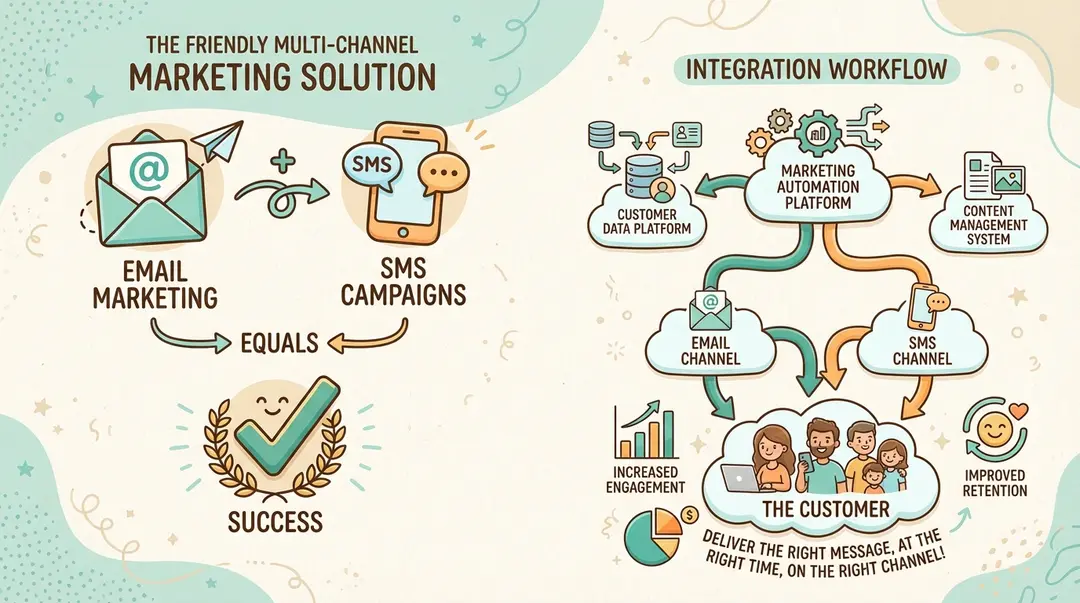
If your email cart recovery is declining, here's the playbook:
1. Add SMS to Your Recovery Flow
Don't replace email—supplement it. The most effective recovery flows use SMS as the first touchpoint (within 1-2 hours) followed by email as a secondary reminder.
2. Stop Relying on Open Rates
For email, shift your focus to metrics that still work: click-through rates, conversion rates, and revenue attribution. Open rates are no longer meaningful for iOS users.
3. Prioritize Speed
The first hour after abandonment is critical. SMS reaches customers in that window; email often doesn't.
4. Enable Two-Way Communication
The biggest missed opportunity in cart recovery is the customer who has a question. If they reply to your email, does anyone answer? With AI-powered SMS, every reply gets an instant, intelligent response.
Immediate First Touch
Send SMS within 1-2 hours of abandonment while intent is still high
Follow Up with Email
Use email as a secondary reminder at 24 and 48 hours
Answer Questions Automatically
Use AI to handle customer replies and objections in real-time
Personalize Based on Behavior
Tailor messages to cart value, product category, and customer history
The Easy Fix
Most Shopify stores already have cart recovery emails set up. Adding SMS takes minutes and can triple your recovery rate. The ROI math is simple: if email recovers 3% of abandoned carts and SMS recovers 10-15%, you're leaving money on the table every day you delay.
FAQ
Is email marketing dead?
No. Email is still valuable for newsletters, brand content, and customers who prefer it. But for time-sensitive recovery campaigns, it's no longer the best primary channel.
What caused the decline in email performance?
Three main factors: iOS Mail Privacy Protection (launched 2021) broke open rate tracking, Gmail's stricter spam filtering sends more emails to spam/promotions, and general email fatigue means customers are slower to engage with marketing messages.
How much better is SMS for cart recovery?
On average, SMS recovers 10-15% of abandoned carts compared to 3-5% for email—roughly 3x better. SMS also has 98% open rates vs 20-28% for email, and 90-second response times vs 90 minutes.
Should I stop sending cart abandonment emails?
No. The best approach is multi-channel: SMS first (within 1-2 hours), email second (at 24-48 hours). Combined, they recover more carts than either channel alone.
Won't customers find SMS annoying?
When done right, SMS has higher customer satisfaction than email. The key is relevance (only message about items they actually looked at), timing (not too frequent), and value (include helpful information or offers, not just reminders).
How do I start with SMS cart recovery?
For Shopify stores, apps like Upsella can be set up in minutes. You'll need to collect phone numbers (popup widgets work well) and comply with SMS marketing regulations (automatic with most apps).
Conclusion
Email abandoned cart recovery isn't broken because you're doing something wrong. It's declining because the channel itself has changed—iOS privacy features, spam filtering, and customer behavior have all shifted against email for time-sensitive messaging.
The stores seeing the best cart recovery rates in 2026 aren't just optimizing their emails. They're adding SMS as a primary recovery channel, reaching customers in 90 seconds instead of 90 minutes, and using AI to turn customer questions into sales.
The good news? Making this shift is straightforward. SMS cart recovery can be added to any Shopify store in minutes, and the ROI is immediate. If you're still relying solely on email for cart recovery, you're leaving significant revenue on the table.
Recover 3x more abandoned carts
Upsella sends AI-powered SMS within minutes of cart abandonment. When customers reply with questions, our AI responds instantly—turning abandoned carts into completed orders.
References
- [1] Litmus. "Apple Mail Privacy Protection Resources." 2025.litmus.com
- [2] Constant Contact. "Apple Mail Privacy Protection for Email Marketing." 2025.constantcontact.com
- [3] Demand Gen Report. "Apple's iOS Changes Are Wreaking Havoc on Email Deliverability." May 2025.demandgenreport.com
- [4] Mailmend. "44 Cart Abandonment Recovery Statistics Every E-Commerce Brand Needs in 2026." December 2025.mailmend.io
- [5] Baymard Institute. "50 Cart Abandonment Rate Statistics 2026." 2025.baymard.com
- [6] Omnisend. "SMS Marketing Statistics and Benchmarks." 2025.omnisend.com
- [7] Red Stag Fulfillment. "Average Cart Abandonment Rate for Shopify." 2025.redstagfulfillment.com
Ready to boost your revenue with SMS upsells?
Upsella automatically sends AI-powered SMS upsells after customer purchases. Start your free trial today and unlock hidden revenue effortlessly.
Related Articles
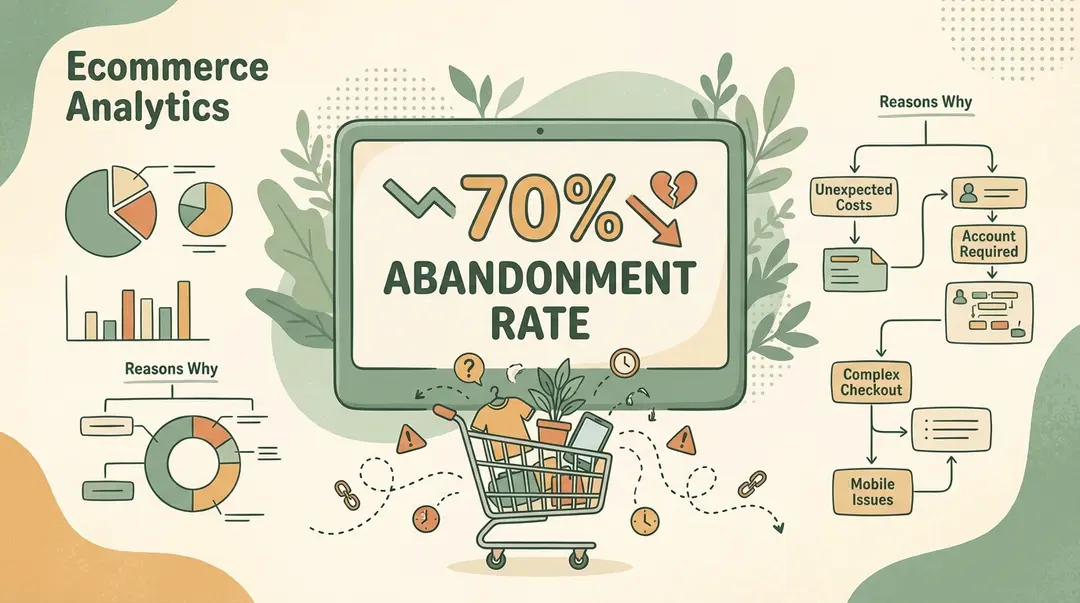
Cart Abandonment Statistics 2026: What Every Shopify Store Should Know
Nearly 7 out of 10 shopping carts are abandoned before checkout. Here
Abandoned Cart Email Templates That Actually Recover Sales (2026)
Cart abandonment costs e-commerce $4 trillion annually. These 7 email templates help you recover 10-20% of lost sales with proven subject lines and a ...
Shopify Store Churn Rate 2026: Why 70% of E-commerce Businesses Fail
E-commerce has the highest failure rate of any business type. Here