Cross-Sell vs Upsell: What's the Difference?
These two terms get confused constantly. Here's exactly what each means, when to use them, and how combining both can significantly boost your average order value.
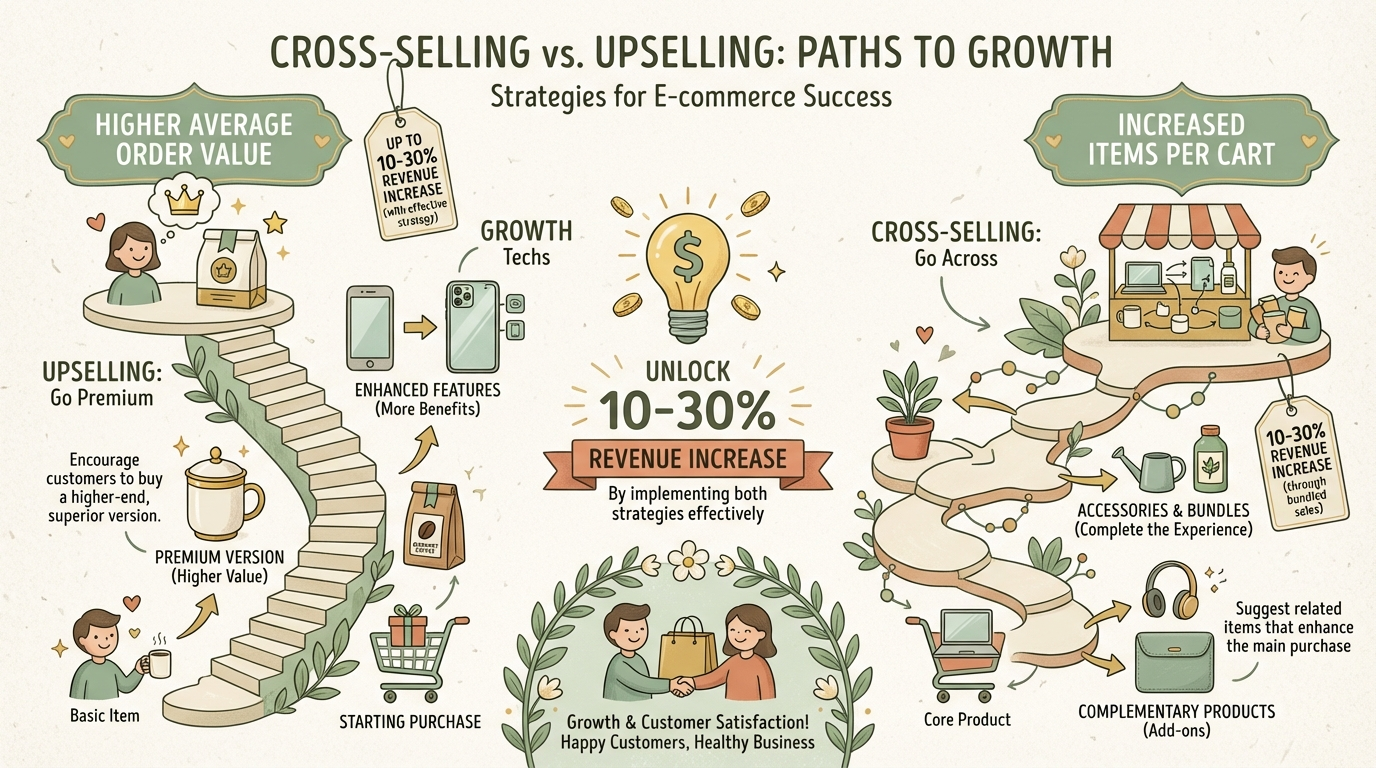
"Upsell" and "cross-sell" are often used interchangeably, but they're fundamentally different strategies. Using the wrong one at the wrong time can hurt conversions instead of helping them.
According to McKinsey, cross-selling and upselling can increase revenue by 10-30% when done correctly[1]. Amazon attributes up to 35% of its revenue to these techniques[2]. But effectiveness depends on understanding which strategy fits each situation.
10-30%
Revenue Increase
From effective cross/upselling
35%
Amazon Revenue
Attributed to recommendations
60-70%
Existing Customer
Probability of selling vs 5-20% new
Definitions: Upsell vs Cross-Sell
What is Upselling?
Upselling encourages customers to purchase a more expensive version of the product they're already considering. The goal is to increase the value of a single item purchase.
Think of it as moving customers "up" the product ladder—from basic to premium, from small to large, from standard to deluxe.
What is Cross-Selling?
Cross-selling suggests complementary or related products that go well with what the customer is already buying. The goal is to increase the number of items in the order.
Think of it as moving "across" product categories—adding accessories, add-ons, or items that enhance the main purchase.
The Simple Distinction
Upsell = "Would you like the larger size?"
Cross-sell = "Would you like fries with that?"
| Aspect | Upselling | Cross-Selling |
|---|---|---|
| Goal | Higher-value version of same product | Additional complementary products |
| Direction | Vertical (up the price ladder) | Horizontal (across product categories) |
| Timing | Before purchase decision is final | During or after purchase decision |
| Customer Mindset | Still evaluating options | Already committed to buying |
Real-World Examples
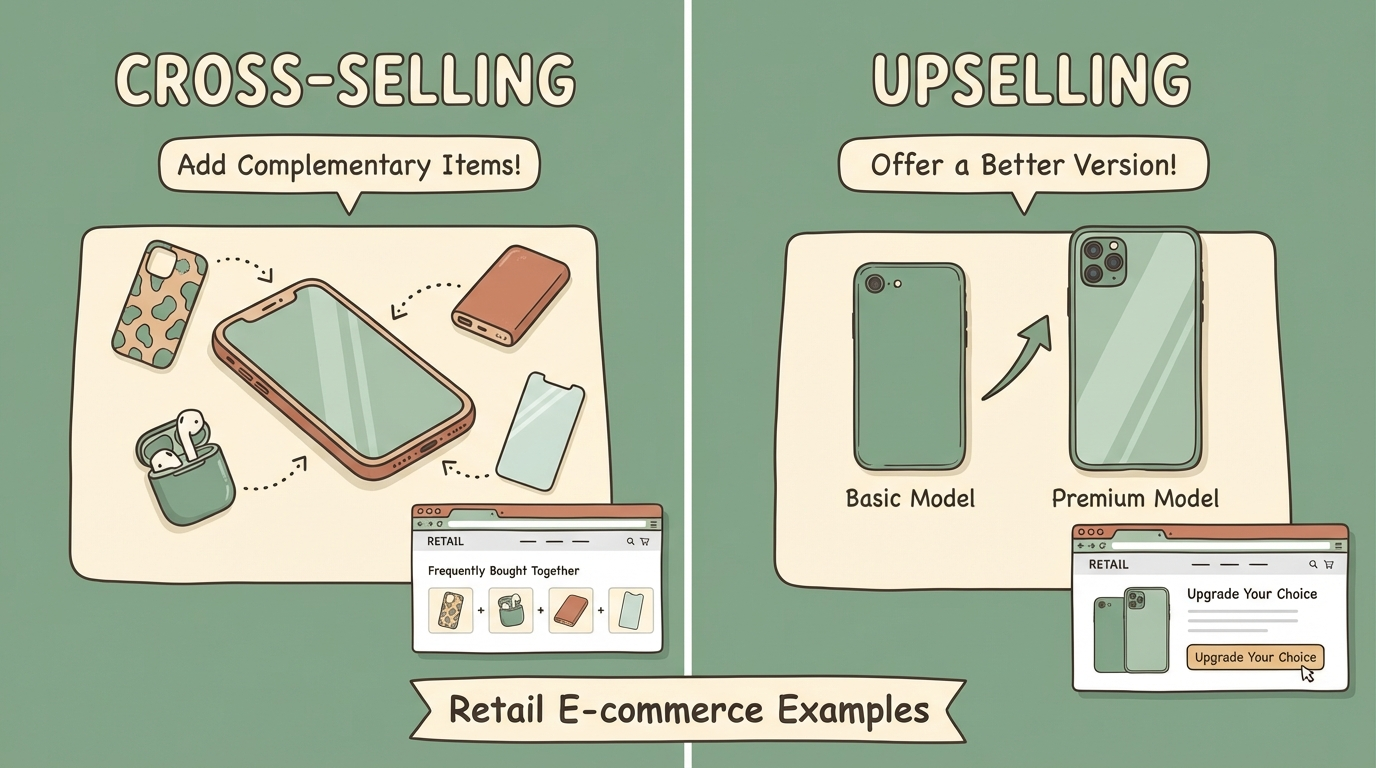
Upselling Examples
Electronics
Suggesting the 256GB iPhone instead of 128GB
Software
Offering annual subscription vs monthly (lower per-month cost)
Fashion
Recommending premium leather version of a bag
Food & Beverage
"Make it a large for $0.50 more"
Hospitality
Room upgrade at hotel check-in
Cross-Selling Examples
Electronics
Phone case and screen protector with new phone
Fashion
Belt and shoes that match the suit
Beauty
Makeup brushes with foundation purchase
Home Goods
Sheets and pillows with mattress
Food
Wine recommendation with cheese purchase
Shopify-Specific Examples
| Store Type | Upsell Opportunity | Cross-Sell Opportunity |
|---|---|---|
| Skincare | Full-size vs travel-size serum | Moisturizer + SPF with cleanser |
| Pet Supplies | 25lb bag of food vs 10lb | Treats + toys with food order |
| Coffee | Subscription vs one-time purchase | Grinder + filters with beans |
| Fitness | Premium yoga mat vs basic | Yoga blocks + strap with mat |
When to Use Each Strategy
Use Upselling When:
Pros
- Customer is still deciding between product options
- Higher-tier product offers clear, tangible benefits
- Price difference is reasonable (typically under 25% more)
- You can demonstrate value, not just higher price
- Product has natural tiers (size, features, materials)
Cons
- Customer has already added item to cart (too late)
- Price jump is too large (sticker shock)
- Benefits aren't clear or compelling
- Customer showed price sensitivity in browsing behavior
Use Cross-Selling When:
Pros
- Customer has committed to main purchase (in cart or post-purchase)
- Complementary products have obvious utility
- Items are frequently bought together by other customers
- Add-ons protect or enhance the main purchase
- Bundle pricing offers clear savings
Cons
- Products have no logical connection
- Suggestions feel random or algorithm-generated
- Too many options overwhelm the customer
- Cross-sell items are more expensive than main item
Timing Matters
Upselling works best before the customer commits to a specific product. Cross-selling works best after they've decided what to buy. Get the timing wrong and both feel pushy.
Revenue Impact Comparison
Both strategies increase average order value (AOV), but they do it differently:
| Metric | Upselling | Cross-Selling |
|---|---|---|
| Typical AOV Increase | 10-30% per transaction | 20-40% per transaction |
| Conversion Impact | Can decrease if too aggressive | Generally neutral to positive |
| Customer Satisfaction | Higher if upgrade delivers value | Higher if suggestions are relevant |
| Profit Margin | Often higher on premium products | Varies by product mix |
Research from Forrester shows that product recommendations (including both cross-sells and upsells) drive 10-30% of e-commerce revenue[3]. The key is relevance—irrelevant suggestions can actually decrease conversion rates.
20%
Profit Increase
From cross-selling (McKinsey)
4%
Cart Addition Rate
For relevant cross-sells
68%
Customers Lost
Due to perceived indifference
Combining Both Strategies
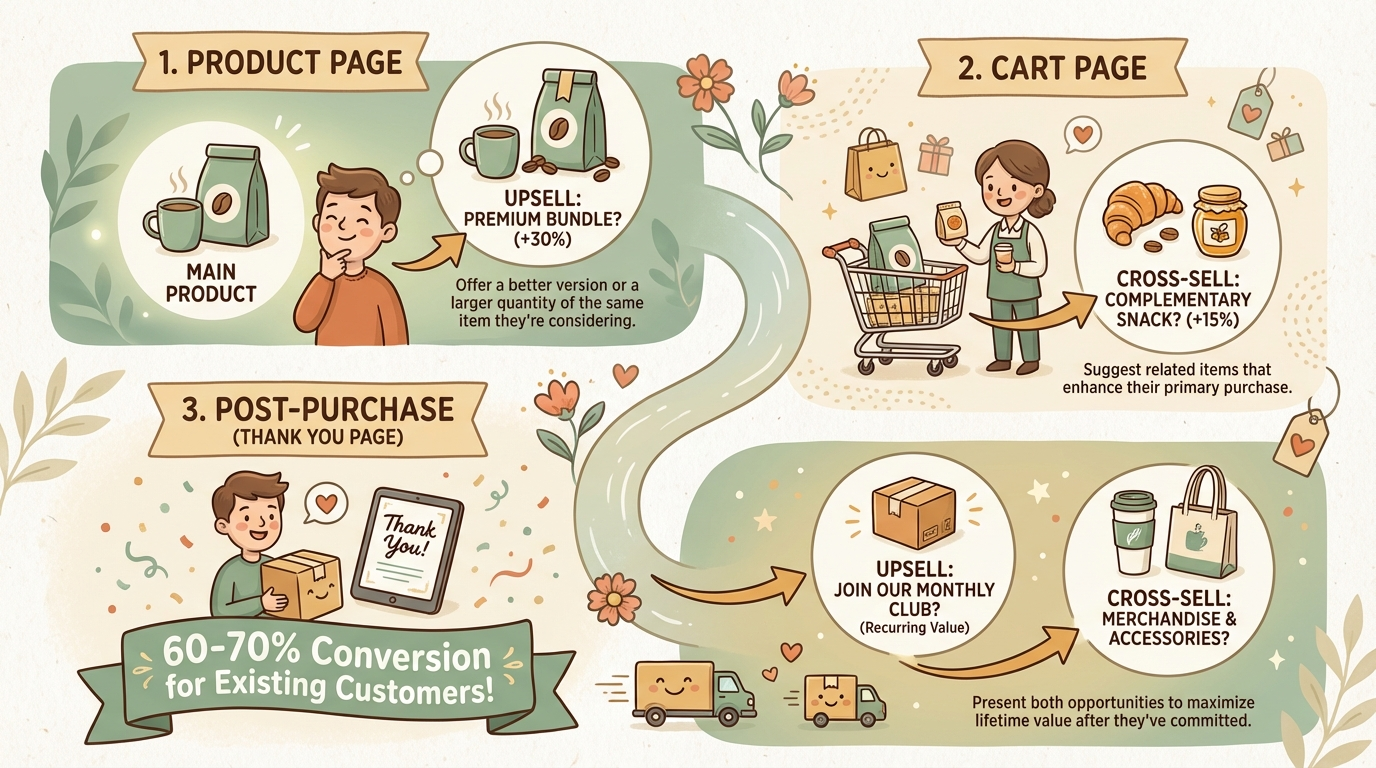
The most successful stores don't choose between upselling and cross-selling—they use both at different points in the customer journey.
The Combined Approach
Product Page → Upsell
Show premium alternatives while customer is still browsing options
Cart Page → Cross-sell
Suggest complementary items once they've committed to main product
Checkout → Light Cross-sell
One-click add-ons (gift wrap, warranty, small accessories)
Post-Purchase → Both
Thank-you page upsells and SMS cross-sells based on purchase
For post-purchase opportunities, SMS outperforms email with 98% open rates, making it ideal for timely cross-sell recommendations. Learn more about how Upsella automates this.
Pro Tip: Don't Overdo It
Limit recommendations to 2-4 items maximum. Too many options create decision paralysis. Amazon shows 4 items in "Frequently bought together" for a reason.
Implementation Tips
For Upselling
Show value, not just price
Highlight what the customer gains—more storage, better materials, longer warranty
Keep price increases reasonable
The sweet spot is 10-25% more. Above that, conversion drops significantly
Use comparison tables
Let customers easily see what they get at each tier
Social proof helps
"Most popular" or "Best value" badges guide decisions
For Cross-Selling
Relevance is everything
Use purchase data and AI to match products logically
Bundle with savings
"Complete the set and save 15%" is more compelling than individual suggestions
Show social proof
"Frequently bought together" leverages herd behavior
Time it right
Post-purchase cross-sells via SMS can reach customers when they're excited about their order
See our complete guide to increasing AOV for more detailed implementation strategies.
Conclusion
Upselling moves customers to higher-value versions of products they're considering. Cross-selling adds complementary products to their order. Both increase AOV, but they work at different points in the buying journey.
The best approach combines both: upsell on product pages when customers are still deciding, cross-sell in the cart and post-purchase when they've committed.
For Shopify stores looking to automate cross-selling after purchase, Upsella's AI-powered SMS can analyze purchase history and send personalized product recommendations at the perfect moment—when customers are excited about their order and most receptive to adding more.
References
- McKinsey & Company. "The value of getting personalization right—or wrong—is multiplying". 2021.
- Forbes. "50 Stats Showing The Power Of Personalization". 2020.
- Forrester Research. "The State of Personalization in Retail". 2023.
- HubSpot. "Cross-Selling: What It Is and How to Do It Effectively". 2024.
Ready to boost your revenue with SMS upsells?
Upsella automatically sends AI-powered SMS upsells after customer purchases. Start your free trial today and unlock hidden revenue effortlessly.
Related Articles
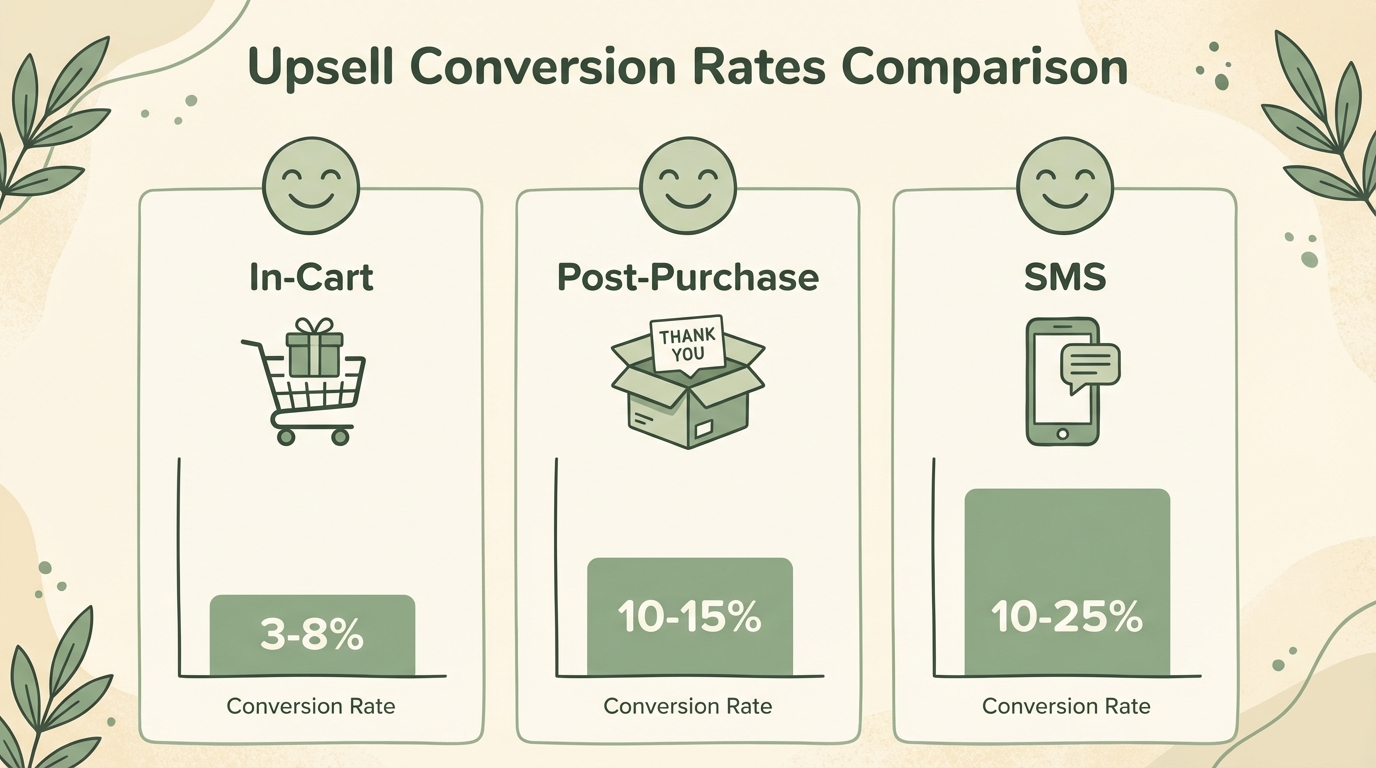
Shopify Upsell Apps Comparison: In-Cart vs Post-Purchase vs SMS (2025)
Not all upsell apps work the same way. Learn the key differences between in-cart, post-purchase, and SMS upselling—and which strategy maximizes revenu...

Best Free Upsell Options for Shopify Stores (2025 Guide)
You don
10 Best Upsell Apps for Shopify in 2025 (Reviewed & Ranked)
We reviewed and ranked the top Shopify upsell apps based on features, pricing, ease of use, and real merchant results. Find the perfect app to boost y...