Shopify Upsell Apps Comparison: In-Cart vs Post-Purchase vs SMS
Not all upsell apps work the same way. Learn the key differences between in-cart, post-purchase, and SMS upselling—and which strategy maximizes revenue for your Shopify store.
Upselling can increase your store's revenue by 10-30%, according to industry research[1]. But with dozens of upsell apps in the Shopify App Store, choosing the right approach matters just as much as choosing the right app.
The three main categories—in-cart upsells, post-purchase upsells, and SMS upsells—each have distinct advantages. This guide breaks down when to use each type and how they compare for driving additional revenue.
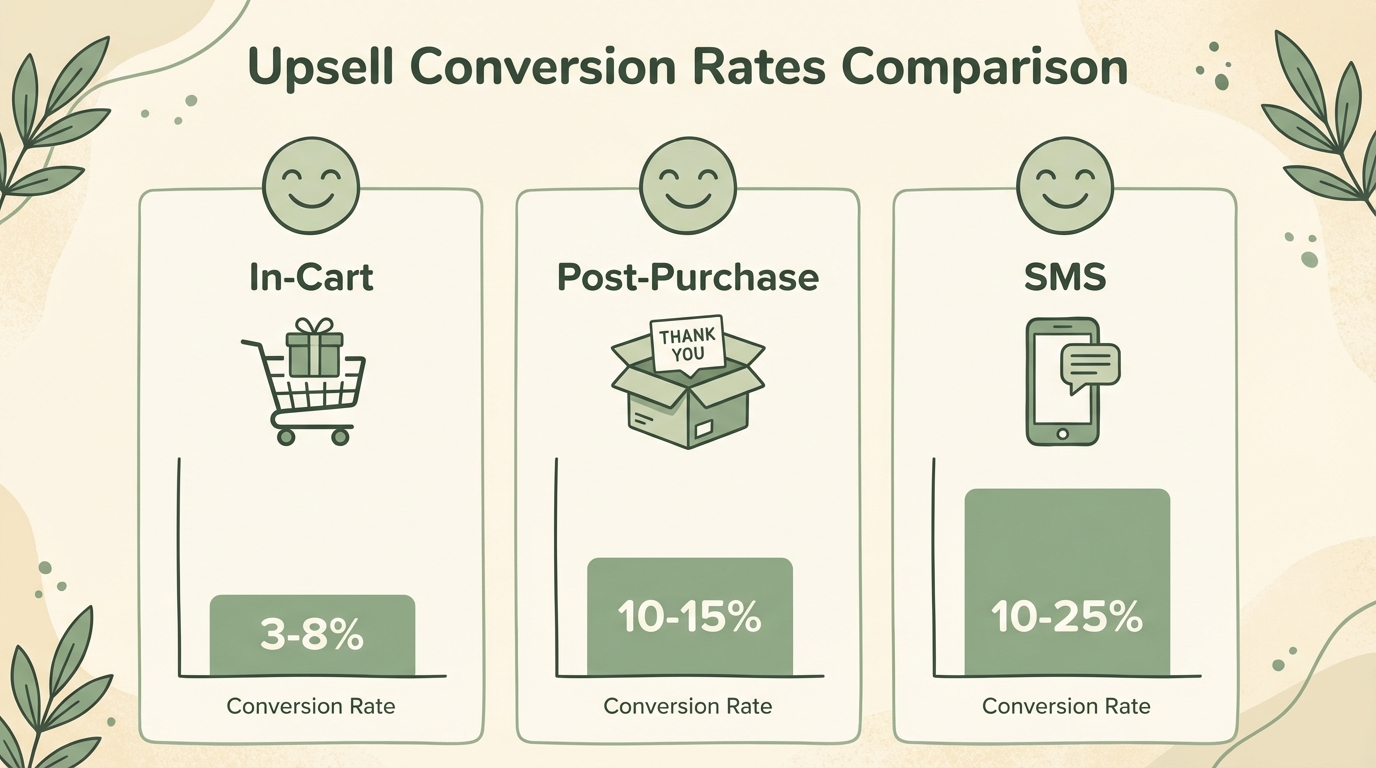
3-8%
In-Cart Conversion
Average upsell acceptance rate
10-15%
Post-Purchase Conversion
Thanks to buyer momentum
10-25%
SMS Conversion
Highest potential with AI personalization
Three Types of Shopify Upsell Apps
Before diving into specifics, here's a quick overview of how each upsell type works:
| Type | When It Appears | Customer Mindset |
|---|---|---|
| In-Cart | While adding items to cart or in cart drawer | Still browsing, not committed |
| Post-Purchase | Between checkout and thank-you page | Just bought, highly receptive |
| SMS | After order, via text message | Off-site, can reach anytime |
In-Cart Upsell Apps
In-cart upsells appear when customers add products to their cart—either as popups, cart drawer widgets, or inline recommendations. Popular apps in this category include Bold Upsell, iCart, and UpCart.
How They Work
When a customer adds a product, the app displays complementary items. For example, adding a phone case might trigger a screen protector recommendation. The customer can add the suggested item without leaving the cart.
Pros
- High visibility – Customers see offers while actively shopping
- Easy implementation – Most apps work with any Shopify plan
- No additional contact needed – Happens within the same session
Cons
- Can increase cart abandonment – Interruptions may distract customers
- Limited timing – Only works while customer is on-site
- One-shot opportunity – Miss the customer if they leave without buying
Best For
Stores with complementary products (accessories, add-ons) where cross-sells make immediate sense.
Post-Purchase Upsell Apps
Post-purchase upsells appear after checkout but before the thank-you page. The customer has already committed to buying, making this a psychologically optimal moment. Apps like ReConvert, AfterSell, and Selleasy specialize in this approach.
How They Work
After payment confirmation, customers see an offer page. With one-click purchase enabled, they can add items without re-entering payment details. Thank-you page upsells can achieve conversion rates up to 15%[2].
Pros
- No risk to initial conversion – The original sale is already complete
- High acceptance rates – Customers are in buying mode
- One-click purchasing – Frictionless add-on experience
Cons
- Shopify Plus required for checkout integration – Basic plans have limitations
- Single touchpoint – Only works at that one moment
- Customer has to complete checkout first – Misses cart abandoners
Best For
Stores with higher price points or product bundles where the initial sale opens opportunities for relevant add-ons.
SMS Upsell Apps
SMS upsells reach customers via text message after their purchase—hours, days, or weeks later. This extends your upsell window far beyond a single checkout session.Upsella is built specifically for AI-powered SMS upselling on Shopify.
How They Work
After a customer places an order, the app analyzes their purchase history and sends personalized product recommendations via SMS. Messages include one-tap purchase links for frictionless buying. You control timing triggers—at checkout confirmation, when the order ships, upon delivery, or on a custom schedule.
Learn more about how this works on our how it works page.
Pros
- 98% open rate – SMS massively outperforms email
- Multiple touchpoints – Reach customers after they leave your site
- Works on any Shopify plan – No Plus requirement
- AI-powered personalization – Recommendations match purchase history
- Runs automatically – Set it up once, generate revenue continuously
Cons
- Requires phone number opt-in – Need consent for SMS marketing
- Per-message costs – SMS has variable costs vs. widget-based apps
- Compliance requirements – Must follow TCPA regulations
Best For
Stores with repeat purchase potential, consumable products, or customers who don't convert on first visit. Check out our case studies to see real results.
Side-by-Side Comparison
| Factor | In-Cart | Post-Purchase | SMS |
|---|---|---|---|
| Shopify Plan Required | Any | Plus (for checkout) | Any |
| Avg. Conversion Rate | 3-8% | 10-15% | 10-25%[5] |
| Risk to Initial Sale | Medium | None | None |
| Timing Flexibility | Low | Low | High |
| Customer Reach | On-site only | On-site only | Anywhere |
| Personalization | Rule-based | Rule-based | AI-powered |
| Automation Level | Manual setup | Manual setup | Fully automated |
Which Should You Choose?
The best approach depends on your store type, products, and customer behavior:
Choose In-Cart Upsells If:
You sell products with obvious accessories
Cases, cables, refills, and add-ons that naturally complement main products
Your checkout flow is already optimized
Low cart abandonment means interruptions won't hurt conversions
You want the simplest implementation
Widget-based apps are quick to install and configure
Choose Post-Purchase Upsells If:
You're on Shopify Plus
Full checkout extensibility is available on Plus plans
Your average order value is high
Customers spending more are more likely to add on
You have clear bundle opportunities
Products that work better together or offer bulk discounts
Choose SMS Upsells If:
You want to reach customers after they leave your site
Continue the relationship beyond the checkout
Your products have repeat purchase potential
Consumables, subscriptions, or seasonal items
You want AI to handle product matching automatically
No manual rule setup required
You're on any Shopify plan (not just Plus)
SMS works regardless of your plan tier
Pro Tip: Use Multiple Approaches
Many successful stores combine strategies. In-cart upsells catch browsers, post-purchase captures the checkout moment, and SMS extends the relationship over time. They're not mutually exclusive.
See our pricing to learn how Upsella fits into your upsell strategy.
Conclusion
Each upsell approach has its place. In-cart works during browsing, post-purchase capitalizes on checkout momentum, and SMS extends your reach beyond a single session.
For stores looking to maximize revenue without risking the initial sale—and without requiring Shopify Plus—Upsella's SMS upsells offer the flexibility to reach customers at the right moment with AI-powered recommendations.
The best upsell app isn't necessarily the most popular one—it's the one that fits how your customers shop.
References
- [1] OptiMonk. "Best Upsell Apps for Shopify". February 2025.
- [2] GemPages. "Shopify Post-Purchase Upsell: Definition & How To Best Implement". 2025.
- [3] Qikify. "Shopify Upsell At Checkout: Proven Strategies With Examples". 2025.
- [4] Shopify. "SMS Marketing Guide: Tips, Examples and Apps". 2024.
- [5] Logbase. "Shopify Post Purchase Upsell: Ultimate Guide To Drive AOV". 2025.
Ready to boost your revenue with SMS upsells?
Upsella automatically sends AI-powered SMS upsells after customer purchases. Start your free trial today and unlock hidden revenue effortlessly.